How the Watchers social solution performed during the World Cup 2026
The World Cup finished, so we can share some insights: what people discussed, when, and how. The data is averaged from the most active sports brands we worked with.


During this year's World Cup, 31 brands across five continents used Watchers social solutions to accompany the tournament. The results went far beyond higher traffic: daily active users doubled across the sports portfolio, the biggest brands grew its activity by up to seven times, and millions of messages revealed something even more interesting.
For many fans, the community chats became more than a place to react to matches—it became a live scoreboard, a player companion, and a community that people didn't want to leave.
—31 brands
—5 continents
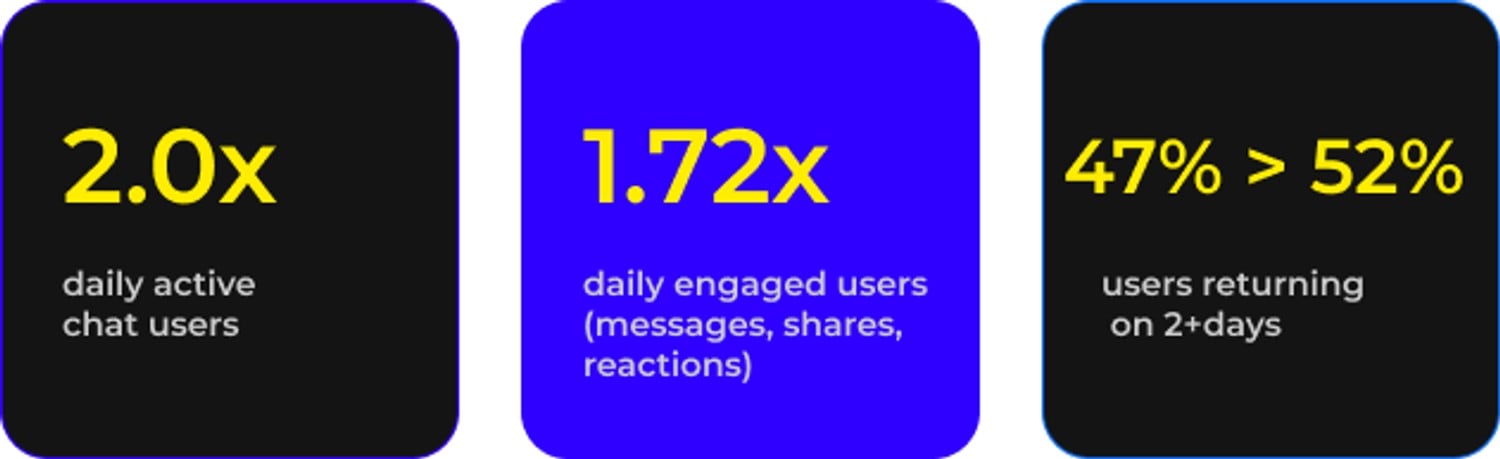
—Social DAU ×2
—Brands activity growth ×3–7
stayed elevated for a whole month
The World Cup doubled the audience activity
31 brands across 4 regions (LatAm, Europe, Africa, Asia) used the Watchers social solution during the World Cup.
We compared all figures for the tournament window with the daily average for the period between April 1 and June 10, the tail of the regular club season (EPL, LaLiga and others):
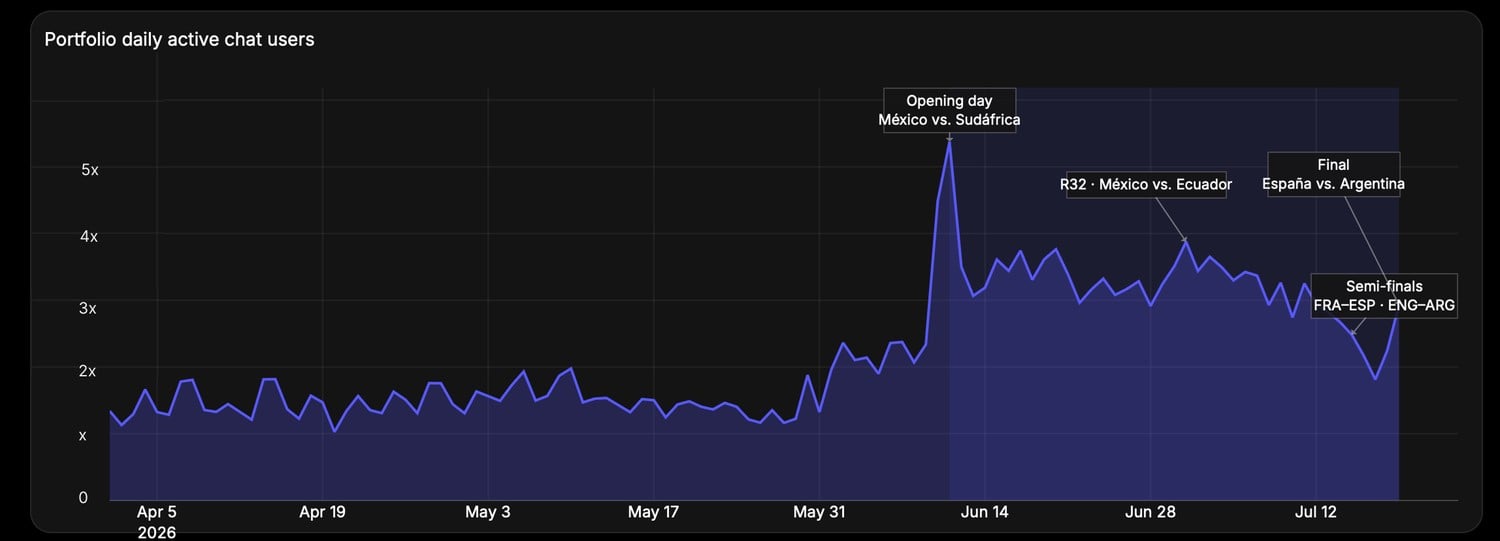
Combined daily active Watchers chat users numbers across the sports portfolio has been doubled the day the tournament started.
The step up on June 11 (opening day, Mexico vs. South Africa) was immediate; activity stays elevated through the final and tracks matchdays of the knockout rounds.
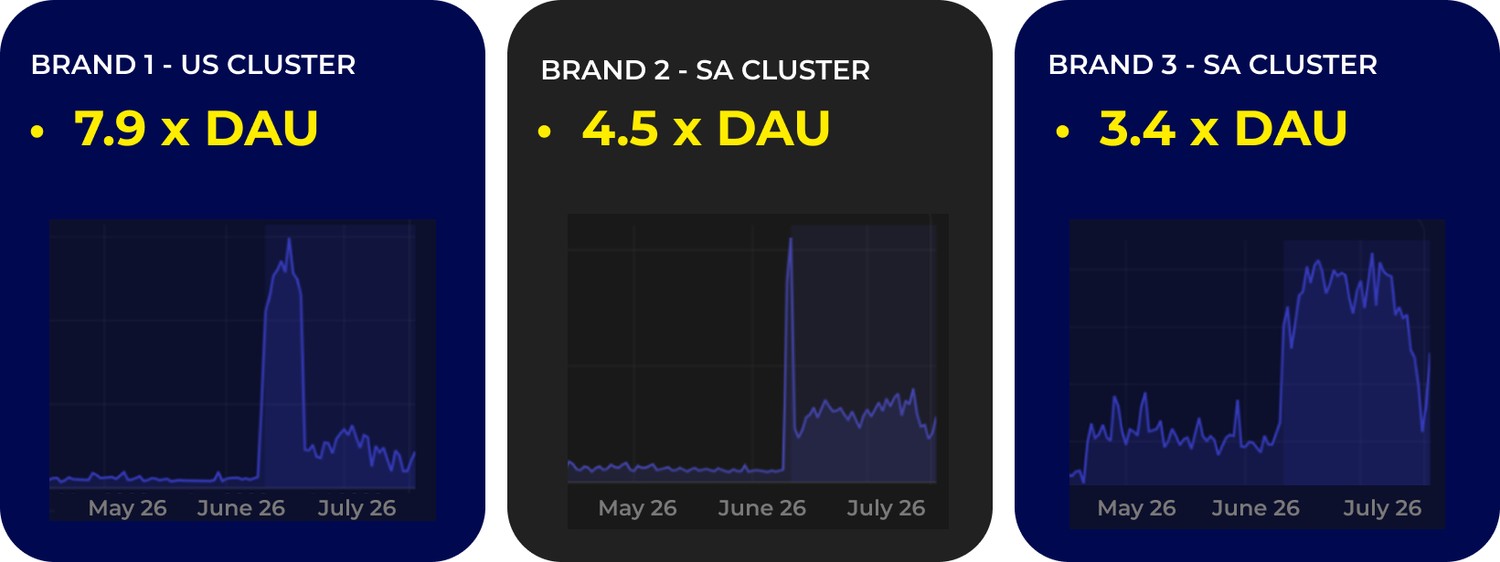
The most active brands increased their social DAU (daily active users) by up to 7x during the tournament. Other platforms saw 3–4× higher social DAU as the event gave users a shared topic to discuss and engage with.
Rooms don’t die at the whistle: post-match talk keeps users on the platform for hours. Pre-match, live, and post-match are three distinct retention surfaces.
Surprisingly, the final wasn't the biggest event
We are operating across various countries and work with clients of very different sizes, so their MAU (Monthly Active Users) varies significantly. Simply combining all numbers to identify for instance the most discussed game, would be unfair. Instead, we first identified the most discussed events on our five most active platforms and then analysed which matches and tournament stages generated the highest levels of user discussion.
The surprise is already spoiled in the headline—it wasn't the final.
Round of 32 (Most active day: July 3)
The Round of 32 generated the highest level of activity across all selected brands.
July 3 was a busy day. It featured Portugal vs Croatia and Argentina vs Cape Verde. Croatia ended Portugal's hopes, while Argentina came surprisingly close to being knocked out by Cape Verde, the tournament debutant from the small island country.
Other Round of 32 fixtures that drove discussion included England vs DR Congo, Belgium vs Senegal, and Mexico vs Ecuador.
Group Stage (Matchday, the first round)
The second matchday of the group stage ranked second in terms of discussion. Key fixtures included Portugal vs Uzbekistan, England vs Ghana, Panama vs Croatia, and Colombia vs DR Congo.
Quarter-finals
The quarter-finals completed the top three, with England vs Norway, Argentina vs Egypt, France vs Morocco, and Spain vs Portugal generating the most discussion.
At first glance, it may seem surprising that the tournament's peak discussion was not the final. But on the other hand, this is not strange. The more games played, the more people watch football. If you support England or Cape Verde and they are not in the final, you might skip the game or pay less attention to it. So, the stages with more favourites were more interesting and appealing to users.
What people actually talked about
The semantic analysis reveals that chat engagement during the tournament extended far beyond discussing football itself. While match events remained the main driver of conversations, users consistently intertwined live commentary with strategies, emotional reactions, platform-related questions, and community humour.
Different brands developed distinct discussion patterns depending on their audience—from referee conspiracy theories and player-specific prop bets to payment issues and statistical disputes—but the underlying behaviour was remarkably consistent. Chat became a real-time companion to the match, serving simultaneously as a live information feed, a betting support network, and a social space built around recurring jokes and streamer personalities. As a result, users stayed engaged before, during, and after the game even despite the fact that all of these platforms didn’t broadcast games, because leaving the chat meant missing information, opportunities, and the shared experience.
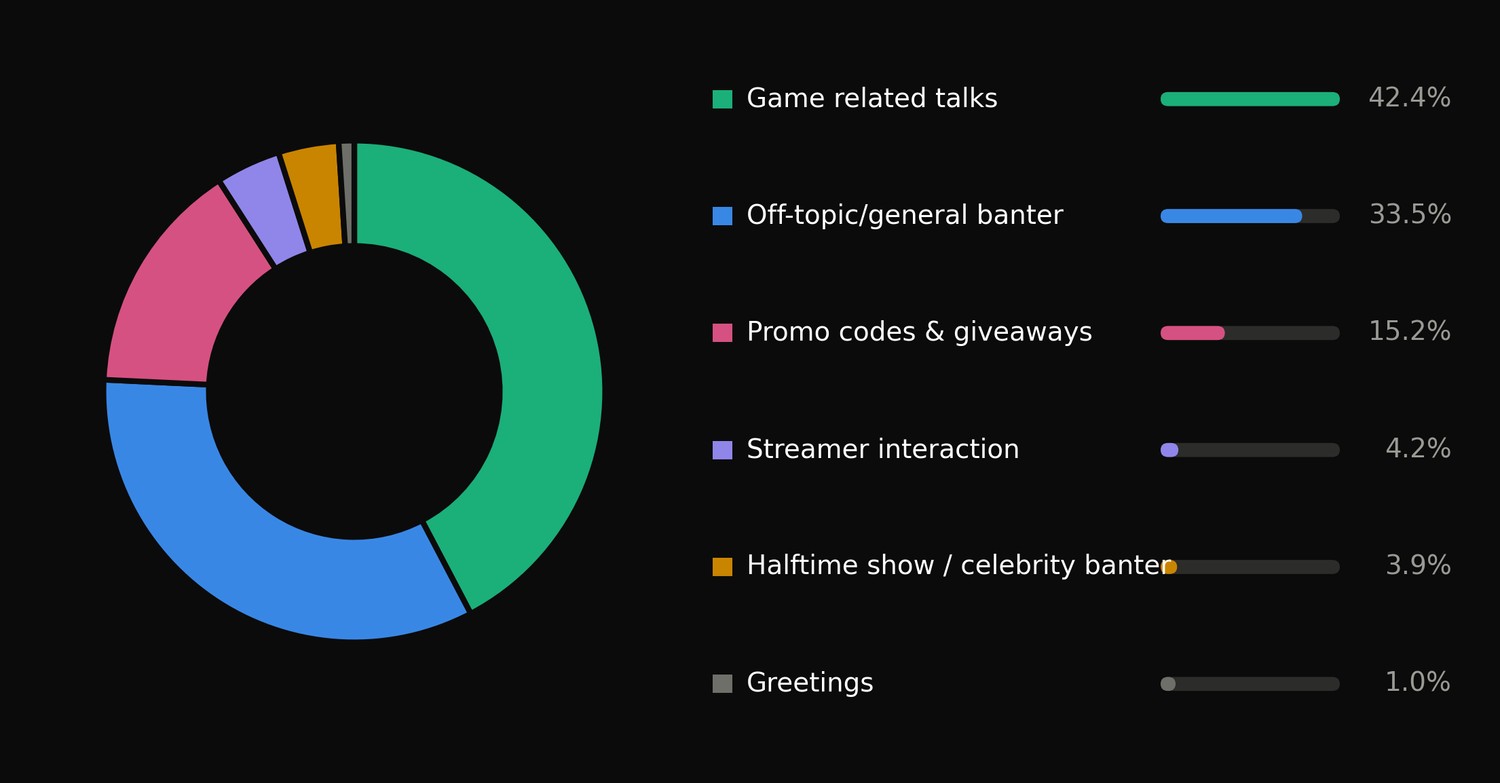
Brand 1, operating in Latin America
Insights
The referee-conspiracy joke ("ArgenFIFA") escalates into an absurd running bit. It starts as ordinary biased complaints ("ese árbitro está vendido") but snowballs into a recurring gag that Messi and FIFA president Infantino are secretly colluding, escalating over the course of the match rather than a one-off complaint.
Prop bets are hyper-specific jokes. Beyond standard markets (corners, cards, both-teams-to-score), people invent joke props tied to the halftime show — "Shakira +1.5", "+1.5 llamadas de Infantino" — treating celebrity cameos and conspiracy jokes as if they were real odd lines.
Brand 2, operating in North America
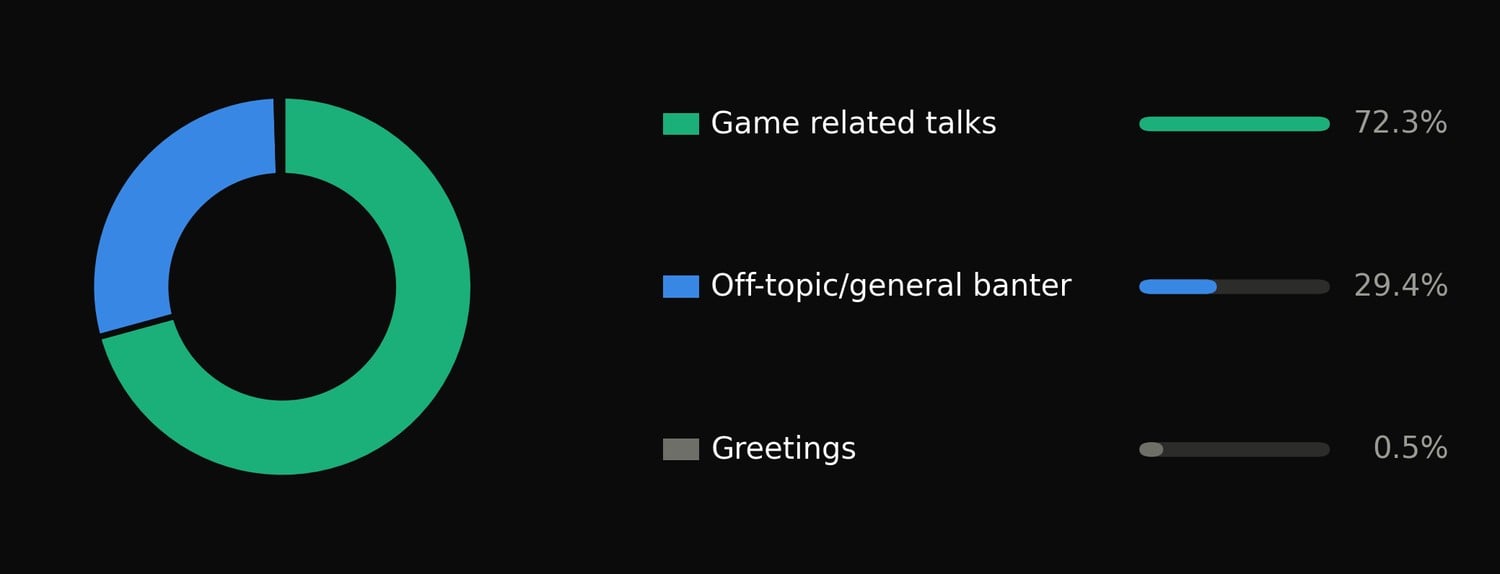
Quarter-final England — Norway analysis (one of the most discussed games)
Insights
The chat is dominated by a running dispute about Haaland's shot-count prop bet rather than general match banter. Nearly half the "officiating dispute" content is people insisting a shot was uncounted: "quitaron un remate a Beli," "no lo contaron," repeated barrages of just "Anulado" (disallowed) over and over.
Haaland himself is the chat's emotional center, more than the match result. People track his shot count ("ya remató Halaand?", "y haaland donde está"), independent of whether England or Norway is actually winning, his individual stat line matters more to this crowd than the scoreline.
ArgenFIFA evolved from referee complaints into one of the tournament's recurring memes.
Brand 3, operating in Europe
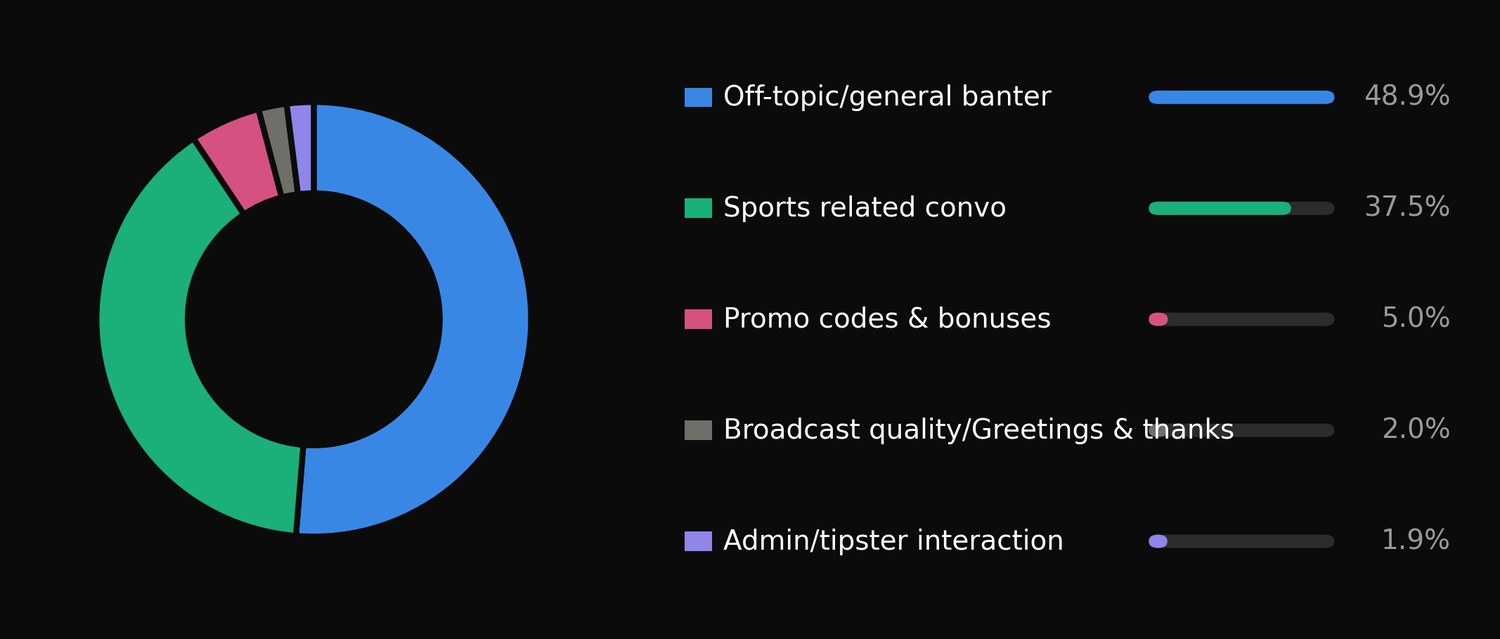
Final game messages analysis
Insights
The conversations are heavily built around Messi-specific novelty props, not just match outcomes. People are discussing odds on whether he gets a red card (odds of 41!), just a yellow card (odds 4.2), or tears his shirt off in celebration. Someone explicitly hopes he "repeats Zidane's 2006 final," a pointed callback to Zidane's headbutt/red card.
There's a visible partisan split, and it's not uniformly pro-Argentina. Several messages openly root against Argentina, and Argentina's play style draws repeated jabs, comparisons to their earlier match against England where they allegedly came out aggressive early. A "fan sector" is mentioned, suggesting there's an organised pro-Argentina block in the chat that others feel outnumbered by.
Live chatter is very specific and math-heavy. People are doing real-time arithmetic on their open slips: "need 2 more Spain goals and 6 more corners," asking whether a 5+ goals total still counts through extra time and penalties, or whether a "Messi to score anytime" prop applies beyond regulation. This is a genuinely engaged crowd, not just casual chatter.
Overall patterns revealed
The chat functions as a crowdsourced play-by-play feed, so leaving means losing the game.
The clearest evidence: "Q paso domingo d mlb q se m perdió el chat y no copie" — "what happened Sunday in MLB, I lost the chat and didn't save it." This user is saying, explicitly, that losing the chat log meant losing the match itself. Similarly: "Como van mis córners???", "Donde esta mi gana españa el primer tiempo", "Q paso ahí lo hicieron out en Home." People asking for basic facts they have no other way to get. Someone has to relay every goal, card, corner, and out, in real time, or the rest of the room is blind.
That's a powerful retention mechanic: you literally cannot look away without losing the thread.
Because of this, specific advice and opinions becomes the reason to keep reading everyone else's messages. That means every person in the chat has an individual, self-interested reason to keep scanning what strangers are typing, which keeps the whole room active even though no one's watching a screen together in the traditional sense.
Running in-jokes reward continuous presence and punish dipping in and out. "ArgenFIFA," Messi/Infantino jokes, "6-7" memes, all of these evolve over the course of the stream. If you show up mid-match, you're behind on the bit; if you stayed the whole time, you're in on it. The platform’s chat becomes the great replacement for users’ favourite social media and messengers, here they are with their mates and speak the same language.
The chat reveals the power of tipsters: users recognise the local influencers, seek their recommendations, and come back to get their opinions. In-chat functions as badges, live streaming, and other features help significantly to create this network which is boosting the platform activity and metrics.
Even without live match broadcasts, platforms have engineered social tools to create a powerful engagement loop. Users need the room to know what's happening, gather trusted opinions, and participate in the ongoing jokes and interactions that create a sense of belonging. Together, all three factors encourage users to stay on the platform with social solutions integrated, as such communities are difficult to replace with generic conversations among unknown people elsewhere.
Get in touch
Looking to bring real-time community engagement to your platform? Whether you're building any sports platforms, media product, or football app, Watchers' community solutions help turn live events into conversations that keep users engaged before, during, and after events.
Get in touch with our team to explore the best solution for your website or app: we'll find the best social solution tailored to your audience and business goals.
Boost your platform with
Watchers embedded tools for ultimate engagement