Beyond the Scoreboard: The Conversations Defining the World Cup™ 2026
Creators and live streamers reveal things that official broadcasters might hide. Brands join the game, goalkeepers' saves mean everything, and communities keep their main role at this tournament. Let’s talk about the first conclusion on the football communication before the World Cup™ 2026 final game.


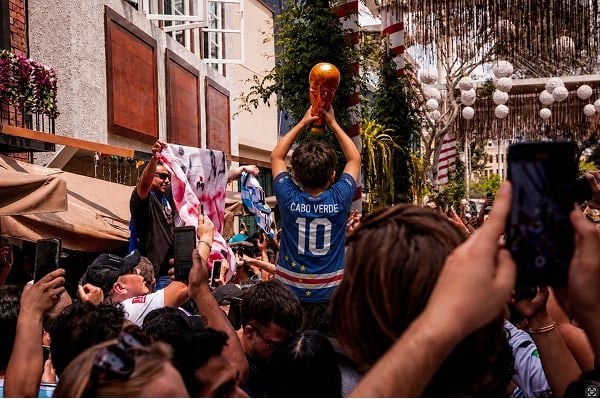
The World Cup™ is being played in stadiums across North America, but its meaning is being created somewhere much larger. Every match unfolds across livestreams, group chats, comments, fan accounts, and brand channels. A referee’s decision sparks a global argument within seconds. A goalkeeper from a small island country becomes an international celebrity overnight. A winning football song revives sentimental memories and makes you support even those teams you actually didn’t plan to.
During the past three weeks, conversations around the World Cup™ have moved far beyond goals and results, not only positive: racist debates this year are higher than in 2022. FIFA has already started several investigations, and more will follow.
Before the last four games, which will bring many more, we already see and analyse the World Cup™ as a global communications event.
Even more teams
Many conversations when the number of participants was just announced were dedicated to the question: why do we need all of these teams, which obviously cannot compete with the front-runners of the Cup? The well-known teams, as predicted, have reached the final stages, but many of the most impressive stories have come from teams that were not expected to dominate.
One of the most memorable teams was Cape Verde, which held Spain to a goalless draw and then met Argentina in the 32nd round, standing equally and lost just in overtime, scoring two impressive goals to Argentina's. Norway eliminated Brazil and reached the quarter-finals. These teams attracted support beyond their traditional fan bases because as they offered something every online community understands: a story worth joining.
Underdog communities are particularly effective at turning spectators into participants. Supporting the favourite can feel predictable. Supporting an unexpected team gives people a shared mission, a distinctive identity and a reason to invite others into the conversation. Norway’s run showed how quickly that identity can expand. Its supporters’ songs, including “Alt for Norge” and “Kongens Menn,” circulated well beyond Norwegian-speaking audiences. The songs became explainers, subtitled clips, reaction videos and shared rituals for international fans who had discovered the team during these weeks.
At the same time, when viewers and analysts had just realised the advantages of the widening of the number of participants, the FIFA director Infantino made a statement to surprise everybody and shared that it is most probable that the World Cup™ 2030 will welcome already 64 countries.
Goalkeepers as the main characters
Strikers usually receive the biggest headlines, but this World Cup™ has repeatedly placed goalkeepers at the centre of the discourse. Morocco’s Yassine Bounou made six important saves despite his team’s quarter-final defeat to France. Courtois’s injury cost the team the next qualification round.
Earlier, Saudi Arabia’s Mohammed Al-Owais recorded nine saves against Uruguay, while Cape Verde’s Vozinha made seven against Spain and Messi’s shots. Vozinha’s performance sparked one of the tournament’s most extraordinary community-growth stories. Before the competition, the 40-year-old Cape Verde goalkeeper had a relatively modest Instagram audience. After his display against Spain, Brazilian broadcaster CazéTV encouraged its viewers to follow him. His account passed one million followers shortly after the match, reached several million within hours and reportedly exceeded 15 million during the following week. Later reports placed it above 20 million.
Safety vs Censorship: Watchers’ Community Moderation
Considering how many penalties the referee awarded and how unpredictable the game can be, the goalkeeper can change everything or simply hold the team’s position. A team cannot win without scoring goals, but if the same team kept a clean sheet, there would be a penalty shootout, turning it into a goalkeeper duel. On social and regular media, the question of the best goalkeepers is one of the most popular and tricky: you can easily find the top scorer by goals, but with goalkeepers, it is more complicated.
Creators are by the pitch and on the pitch
Livestreamers and online creators haven’t been sitting outside sporting events for many years already, but this time their influence grew wider than just operating as parallel broadcasters. This changed the perception of the tournament a lot because, compared to traditional broadcasters, it allows chatting while watching, replying to the streamer, and combining both live and digital experiences. Live streaming also increased the overall visibility of events during the tournament.
One scandal involved YouTube creator IShowSpeed, who streamed the Argentina vs Cape Verde game. During the stream, a spectator made an apparent racist comment at him. The moment was captured live, spread immediately, and became international news. FIFA opened an investigation and condemned racism and discrimination. The incident showed both the power and vulnerability of creator-led media. A traditional broadcaster might have missed or chosen not to air it. A livestream made the incident instantly visible and preserved the audience’s real-time reaction. Also, such visibility increased pressure for an institutional response. Creators therefore influence which incidents become public, how quickly they spread and what institutions are expected to address.
Athletes continue to be influencers, with Erling Haaland as the most popular example this year. CNN published articles like “Why everyone loves Erling Haaland, Norway’s giant blonde striker.” Bloggers made video essays about why everyone is obsessed with him. Football fans cannot avoid the funny videos he records for Snapchat or edits about him. “If you ask Americans, Norway's Erling Haaland is already a winner,” a BBC journalist writes. NBC News says the same about Chinese football fans. Messi, Ronaldo, Neymar, and Modrič are playing their last World Cup™, but the new generation seems even more popular now, not just for their football stats.
Stadium tracks as a shared language
Fans and athletes communicate through songs, gestures, slogans, recurring jokes, and visual references to folklore, traditional or new. Songs become part of the team’s brand and tradition. The further the team goes, the more fans sing the team’s song together at the stadium, making it more viral.
Each team chooses their song, which plays when the team is winning. Some teams choose more than one track, like the French national team: they dance to “Freed from Desire" by Gala when they win, but they also turn on Daft Punk’s “One More Time” when they score a goal.
One of the most touching songs picked by the English team is Wonderwall by Oasis, which they play and sing together with fans. Even Noel Gallagher, the author of the song and Oasis musician, said that "Wonderwall belongs to the people." When they sang it with fans during the group stage game, it seemed a bit much. But with every new game, emotions grew stronger, and game by game, the English team became a true chore. The English team fans regularly apply to the britpop heritage: when Jude Bellohgham scores, they sing Hey, Jude, the Beatles hit.
Argentina has chosen Los Fabulosos Cadillacs' "El Matador" (which literally means "the killer") as their warm-up and goal song. The track’s repetitive "Matador! Matador!" reflects the team’s playing attitude. Another song, which is especially relevant to the game against England, is "Fourth Star," familiar to fans a long time before this World Cup™. It includes the reference to the Malvinas, the 1982 war with the British for possession of the Atlantic islands.
When Spain wins, the immediate post-match track played by the stadium DJ or used by fans is typically "Potra Salvaje (Hard Remix)" by Isabel Aaiún or "DESPECHÁ" by ROSALÍA. Among other musical hits we heard recently,
Australia's signature tune is Men At Work's classic "Down Under," and Belgium's techno anthem is "Pump Up the Jam" by Technotronic. The US team played John Denver's "Take Me Home, Country Roads." The Norwegian team, beyond their Vikingblod (Norway Row Chant) and Alt for Norway, also had a huge hit for wins, for instance against Brazil: “Take On Me” by a-ha.
Racism cannot be treated as a side conversation
The IShowSpeed incident, which FIFA has started to investigate, as we described above, is just one among many more critical racist situations that erupted at this World Cup™. French Football Federation filed a lawsuit against a senator from Paraguay for the racist twits against the French striker Kyllian Mbappe.
This growth of hate speech on social media makes moderation and quick response central responsibilities for all participants, organisers, media, and community support.
For tournament organisers, platforms, broadcasters, and brands, silence sends its own message. Communities expect institutions not only to condemn racist behaviour but also to explain what action is taken, how quickly, and whether affected people are supported.
The online conversation is not separate from the stadium environment. It is now one of the principal places where accountability is demanded.
Online Community Moderation Strategies: A Practical Playbook
During the World Cup™ in Qatar, the level of violations was the highest in FIFA history, breaking previous records. FIFPRO issued a statement about the growing racist abuse online and offline. The Guardian explains this by linking the rise in online abuse to the global political climate: “divisive political rhetoric is translating into an intensifying challenge for players on the pitch: a surge in racism” (Ashifa Kassam).
Huge organisations publish community guides and try to support everyone facing violent behaviour online and offline. However, with the explosion of incidents during this tournament, conclusions can only be made after it finishes and all data is analysed.
Mistaken identities
Argentina’s route through the knockout stage has generated some of the tournament’s most intense discussion, along with the cancelled red card of USA player Folarin Balogun before the game with Belgium. In the round of 16, Egypt appeared to take a two-goal lead before Mostafa Ziko’s goal was disallowed following a VAR review. Officials identified a foul much earlier in the attacking sequence, prompting arguments over how far VAR should reach back when reviewing a goal. Egypt eventually lost 3–2 after surrendering its lead late in the match. The conversation continued during Argentina’s quarter-final against Switzerland.
A VAR intervention resulted in Swiss forward Breel Embolo receiving a second yellow card for simulation after the original booking had been shown to Argentina’s Leandro Paredes. The unusual application of the mistaken identity rule left Switzerland playing with ten men for more than an hour. Swiss players, coach Murat Yakin, and millions of fans publicly questioned both the decision and the rule behind it.
Online, those incidents developed into a much broader narrative about Argentina, refereeing and the treatment of major football nations. Some commentators and supporters alleged that Argentina was being favoured. There is no verified evidence that the tournament is being manipulated for Argentina, but that did not prevent the accusation from becoming a recurring social-media storyline and even the traditional media discourse.
Brands entered the game
Ahead of England’s quarter-final against Norway, Norwegian Air challenged British Airways to a public pari on Instagram. The rules were simple: the airline representing the losing nation would temporarily replace its Instagram profile picture with the winner’s logo. Norwegian asked if British Airways was ready to “risk your logo.” British Airways accepted. When England won 2–1 after extra time, Norway followed through and changed its profile image to the British Airways symbol. Other airlines joined the joke exchange. Malaysia Airlines noticed that most airlines would need “six months and 14 approvals” to change a logo. The activation worked because it was easy to understand, visible, and genuinely connected to the match’s uncertainty.
Community as the blood of the tournament
We’ve already written about the huge influence and wide meaning of the FIFA fan zone for people worldwide, including those living in the host country who cannot afford tickets. This applies in all countries and cities. In New York, communities dedicated to various World Cup™ participants were described by Mayor Mamdani—how watch parties help people not just support the team but stay connected and feel at home.
The more connected and shared the experience is, the longer it will influence the world.
The story of Cape Verde is outstanding in the community aspect as well. Cape Verde is a small island country, but its nationals live worldwide. A World Cup™ match becomes a rare moment when communities across islands and countries experience the same event simultaneously. The widespread support of the team can compete with fan communities of bigger countries as the team competes with World Cup™ leaders.
For supporters of the impressive Egyptian team, traditional coffee houses in the country became the replacement for the FIFA fan zones and public stadiums. The gathering was not merely about watching football: it allowed people to experience pride, disappointment and national identity as a group rather than as isolated viewers.
Morocco’s victory over the Netherlands created one of the tournament’s most complicated community moments. For many Dutch citizens of Moroccan heritage, the match brought national identity, family history and migration into the same public celebration. Moroccan fans in France, when they lost in the quarter final, celebrated the qualification of the French team together: due to shared history and the fact that many Moroccan players play for French clubs. It helped two teams and their fans stay connected and celebrate football, not going to violations.
Some early conclusions after
Moments VS status. Vozinha did not start the competition with the largest personal brand, but his performance, combined with collective action from a creator community, transformed his visibility and that of the whole community.
Communities keep a role. Following a goalkeeper, singing a song, debating a decision, or watching a brand complete a wager gives audiences something to do, not just something to consume. Communities have always been main parts of the football experience; this tournament shows it hasn’t changed: football exists because of communities, and fans are as crucial participants as the eleven on the pitch. Creators are media channels. They can break stories, expose harmful behaviour, and mobilise large audiences without using a traditional broadcaster.
Creators give fans a choice not accessible with linear broadcast. Official rights still belong to huge broadcaster conglomerates, but as the number of games grows and all games become impossible to watch, creators’ channels are a source of information.
Humour works when participation feels real. The Norwegian–British Airways exchange succeeded because both sides publicly accepted the consequences. When brands do not just observe but become part of the discussion in real time, it changes much for them.
Visibility creates responsibility. Racist incidents, abuse, and discrimination can reach large audiences immediately. Institutions must be prepared to respond at the speed of the community. Moderation and community rules remain crucial as communities grow and emotions explode.
Read how engagement influence sports teams, companies, and technologies
Boost your platform with
Watchers embedded tools for ultimate engagement


