From USA 1994 to World Cup™ 2026: How Football Has Changed in North America
From World Cup™ 1994 to 2026, see how the perception of so-called European football changed alongside a wider North American sports culture, and how it is now shaped by digital media and fan communities.


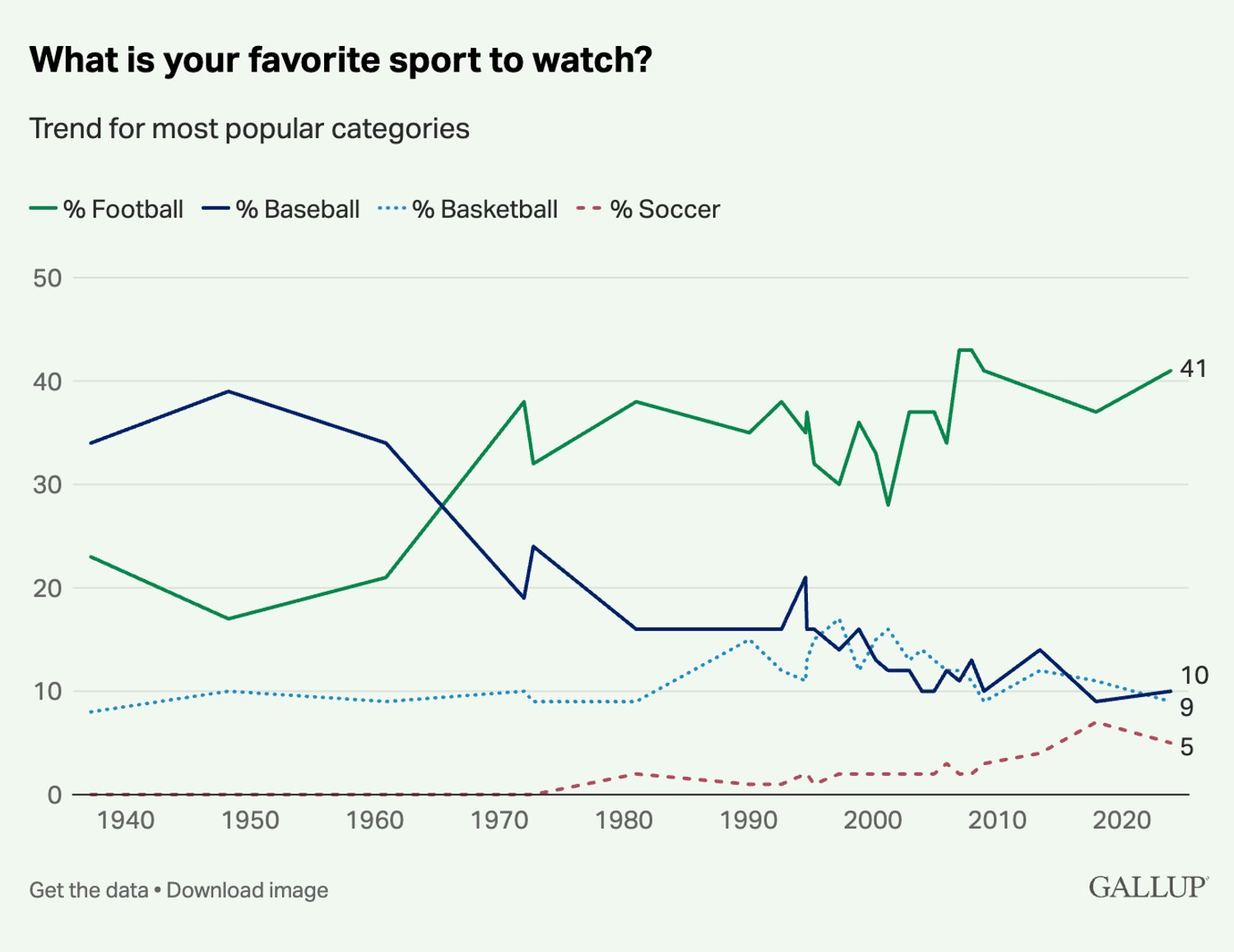
When the United States hosted the FIFA World Cup™ in 1994, football, or as Americans got used to calling it, soccer, was not yet a mainstream sport in the country. The NFL and MLB were the most anticipated sports events by a wide margin. According to a 1994 Gallup poll, American football was the most popular sport to watch in the United States (35–37%), followed by baseball (16–21%), while only around 2% of fans said they watched soccer (the version played in the FIFA World Cup™).
While American audiences didn’t have an interest in professional football at that time, those four weeks of the FIFA World Cup™ were there.
Now, in the summer of 2026, the FIFA World Cup™ is back in North America, and the preparations for the tournament are entirely different from what they were three decades ago. Media coverage and social media discussions around each match are happening at a massive scale. Mobile apps and streaming platforms covering the tournament have also attracted enormous audiences, reflecting a completely different digital reality around the tournament.
USA 1994 was a test for football, and what the 1994 World Cup™ left behind
Before the tournament kicked off, there was naturally a lot of speculation that it would not get the viewership and popularity it deserved because American audiences had never shown sustained interest in so-called European football. The North American Soccer League, which once drew enormous crowds, especially because of global superstars like Pelé and Franz Beckenbauer, collapsed by 1984 due to financial instability and declining club participation.
This meant that the 1994 FIFA World Cup™ was hosted by a country without a professional soccer league. The numbers showed something unexpected. The tournament recorded the highest-ever total attendance at a World Cup™, with around 3.6 million fans watching matches in stadiums. The average match attendance of 68,991 per game was also record-breaking.
During the tournament, the US national team reached the round of 16 for the first time in 64 years, which was also important for high interest. Around 11 million Americans watched the round-of-16 match between the USA and Brazil, a figure that reflected a level of interest few had anticipated before the tournament.
Beyond the numbers, there was also a lasting structural impact. The USA and Canada's Major League Soccer (MLS), a domestic club competition, was established soon after the World Cup™ and began play in 1996, just two years after the tournament, with 10 teams. The league has since become one of the fastest-growing football competitions, making soccer a popular sport in the USA.
How the football landscape in the USA has changed by 2026
The early years of MLS were difficult. The league lost millions in its first five years, and two franchises also folded after the 2001 season. But it was rebuilt and kept growing. Today, MLS has 30 clubs competing across the United States and Canada, and a huge viewership.
The 2025 MLS season was watched by 3.7 million fans per week across streaming and linear platforms, which is a huge (29%) increase from 2024. MLS social media channels also posted 798 million impressions during the 2025 MLS Cup alone.
In the first three months of 2026, that figure has almost doubled, with as many as 7.9 million fans watching the league matches every week. MLS and club social channels have now also reached around 113 million followers globally. These numbers reflect how much football has grown in North America since 1994.
Lionel Messi joining Inter Miami in 2023 also dramatically boosted interest domestically and globally. According to Nielsen’s The Fans Behind the Game report, his debut match against Cruz Azul boosted linear TV viewership by 173% compared to the tournament average. It drew 1.75 million viewers on Univision alone, and a single clip of his free-kick goal from the match became MLS's most engaged post ever across all social media platforms with 6 million engagements.
Messi’s arrival also brought back a long-running debate that the MLS is a “retirement league” for ageing European stars, as critics call it. They point to a noticeable trend of prominent names such as David Beckham, Thierry Henry, Andrea Pirlo, Zlatan Ibrahimović, Frank Lampard, and Steven Gerrard spending their final playing years in the United States.
But many believe that with Messi’s arrival, MLS is now seen as a serious league because he joined it not at the end of his career, but still at a competitive level. As the United States Men’s National Team (USMNT) star and Inter Miami rival Tim Parker put it: “He’s still playing for Argentina, he’s still scoring goals on the international stage. Yes, he’s still scoring goals in MLS, but it’s not like he’s not doing it against the best in the world on other stages as well. So I think we have to really rationalise that thought process of guys coming over here as a ‘retirement league’ because that’s just not the way it is anymore.”
American soccer fans have also started to take more interest in European football over the years, alongside MLS. NBC Sports, which holds the Premier League broadcast rights in the US, has seen consistent growth in US viewership.
The opening weekend of the 2025-26 Premier League season became the most-watched opening weekend in the United States with an average of 850,000 viewers across NBC, Peacock, and USA Network. During the same weekend, a match between Manchester United and Arsenal became the second most-watched Premier League match in US history at that time, with 2.3 million viewers, including Spanish-language coverage.
Recently, a Premier League match between Manchester City and Arsenal in April 2026 was watched by as many as 2.6 million fans in the US, becoming the most-watched Premier League match in U.S. history.
The USMNT's development and the USA World Cup™ history are also quite impressive. With the exception of missing the 2018 tournament, the US has been a regular at the FIFA World Cup™, advancing to the Round of 16 in 2010, 2014, and again in 2022. The investment in youth development programs such as MLS NEXT is building a strong foundation for the national team and is a clear sign of the growth of soccer in the US. The squad that travelled to Qatar featured players from top European leagues: Christian Pulisic at AC Milan, Weston McKennie at Juventus and Gio Reyna at Borussia Dortmund. It’s a generation of stars built through youth development that simply didn't exist in 1994.
Soccer is now a popular sport in the US, as millions of fans are ready to watch the FIFA World Cup™ 2026 and support their national team. According to Nielsen’s The Fans Behind the Game report, there is an 11% increase in the soccer fan base in North America from 2020 to 2025, and soccer is now among the top 5 sports in the U.S., with 62.5 million fans.
Why the World Cup™ 2026 is a different kind of tournament
The gap between the FIFA World Cup™ 1994 and the World Cup™ 2026 is noticeable. The 1994 tournament had 24 teams and 52 matches across one country (the US). The 2026 World Cup, by contrast, is much larger in scale. It features 48 teams, 16 host cities across three countries (the United States, Canada, and Mexico), and 104 matches over 39 days.
It’s the first time three nations have jointly hosted the World Cup™, and the first time 48 teams have competed. The US alone is hosting 78 of those 104 matches across 11 cities, including the final at MetLife Stadium in New Jersey.
The longer format means more fan communities will watch the tournament through their own cultures, traditions, and expectations. Many of the newly qualified nations are bringing fanbases who have little or no experience of the World Cup™ before. But what they do have is intense loyalty to their national teams. For broadcasters and sports platforms like streaming apps, this is a genuine opportunity to reach entirely new audiences.
The new knockout format means there will be a 32-team playoff, which gives more nations a real chance of progression and keeps more fanbases engaged deep into the tournament with more high-stakes win-or-go-home moments.
The tournament also has some new rules to cut time-wasting and increase match tempo, such as:
* A ten-second limit on substitutions
* A five-second countdown for throw-ins and goal kicks
* A requirement that injured players leave the field for at least a minute
These rule changes mean faster, tighter matches, which matter as much for digital engagement as they do for the 90 minutes on the pitch.
More teams and more nations will also mean more viewers and a huge opportunity for engagement for sports and streaming apps. The numbers from the last World Cup™ in Qatar were already impressive: FIFA's own social media channels generated 811 million engagements, a staggering 448% increase over the 2018 World Cup™ in Russia. FIFA video views across platforms also reached 3.6 billion, up around 202% from the prior one.
For North America, the FIFA World Cup™ 2026 is also a completely different kind of experience from the tournament in 1994 in terms of preparations. FIFA has officially announced Fan Festival sites across all 16 host cities, and individual cities have also added their own fan zones. Los Angeles confirmed multiple fan zones and community events, while New York and New Jersey have scheduled free official fan events throughout the tournament. This simply didn’t exist in 1994 at any comparable scale.
World Cup 2026 is not simply a bigger version of 1994 or other previous tournaments. It is a tournament designed for a fanbase that watches, scrolls, reacts, and discusses all at the same time, and the format, the rules, and the digital infrastructure around it have all been built with that in mind.
A new generation of football fans in North America
The North American soccer fanbase looks pretty different today than it did three decades ago. It’s broader and more diverse. According to Nielsen's 2025 The Future of Sport report, the US soccer fanbase is 76% Millennials or Gen Z, 22% Hispanic. Nielsen’s The Fans Behind the Game report also revealed that the average age of a U.S. soccer fan is 33 years.
The North American soccer fanbase is actually multi-layered. It includes longtime MLS supporters who grew up watching their local clubs, fans of European leagues who follow Premier League or La Liga action through streaming services, and communities tied to national teams from their home countries. Nielsen’s The Fans Behind the Game report found that roughly a quarter (26%) of today’s North American fanbase has come on board in the last five years, showing the fanbase is actively being built.
The fanbase also includes a younger cohort who may never have watched a full 90-minute match but follow the sport intensely through short-form video and social media. According to the Nielsen The Fans Behind the Game report, 11% of Americans who don't consider themselves sports fans at all expect their interest in soccer to grow ahead of the 2026 World Cup™.
The same report also found that 68% of existing fans in the U.S. say their interest has grown in the past three years, and 64% believe it will continue to climb. At the same time, 33% of the general population expects to become more interested in soccer during and after the FIFA World Cup™ 2026.
From linear TV moments to real-time digital reactions
Back in 1994, watching games was a very different experience. Fans either had to go to the stadium or plan their entire day around the TV broadcast. If you missed a game, there was no way to replay it instantly. There was no online streaming, no apps, and no live online coverage. Most of the post-match discussion happened the next day at school or work.
Today, everything is very different. Fans now increasingly watch sports on streaming platforms and engage with match-related content even after the game ends. An S&P Global Market Intelligence survey revealed that about 68% of U.S. sports fans watch live sports via TV or streaming services. It also showed that 38% of Americans regularly watch online sports highlights, clips, and interviews across platforms.
Fans today also want to share their emotions about the game instantly and react together in real time. When a reaction-worthy moment happens, they quickly discuss it across social media, messaging apps, dedicated platforms, in-app communities, and comment sections.
The same trend is expected to continue during the 2026 World Cup™. Nielsen’s The Fans Behind the Game report revealed that as many as 59% of US FIFA spectators fans plan to engage on social media during the 2026 World Cup.
Why fan communities are becoming part of the match experience
A Deloitte survey found that 77% of sports fans around the world multitask while watching live games. These include activities like:
* Checking stats
* Playing fantasy sports
* Using social media to post reactions, read comments, and interact with other fans during the match.
An IBM survey also revealed that community engagement was a top priority for 9% of fans in 2024, rising to 11% in 2025. It shows that fans increasingly want to interact with other fans during and after the game.
Beyond these interactions, fans also want to access live statistics as well as features like live chat, polls, real-time reactions, fan rooms, Q&A, and post-match discussions. Sports platforms that provide these features can attract more fans and keep them on their platform. This matters not just during a tournament, but after it ends. The fans that platforms attract during the World Cup™ 2026 are the fans they need to retain when the tournament ends.
For example, the UEFA Champions League app is built to keep fans engaged before, during, and after games. Fans can access real-time stats and a live commentary feed during live matches and also interact with features like fan voting (Man of the Match) and post-match highlights.
Watchers helps sports platforms and websites provide that same kind of experience in their own apps by embedding community features, such as interactive match chat, fan clubs, reactions, polls, AI-powered Q&A, and moderation tools. If you plan to upgrade your website or app to be a social one, book a call with us.
FAQs about the World Cup™ 1994 vs 2026
Why was the 1994 World Cup™ important for football in North America?
It was the first FIFA tournament held in the United States and was one of the most successful World Cups in terms of stadium attendance, with a total attendance of 3,587,538 across 52 matches. The tournament was also the core reason behind the launch of Major League Soccer in 1996.
How is the 2026 World Cup™ different from the USA 1994?
World Cup™ 2026 is the first tournament co-hosted by three nations and the first to feature 48 teams competing in 104 matches across 16 cities. Beyond the format changes, the fan landscape is completely different: millions of soccer fans now follow the sport in North America and are ready to engage through streaming and social media platforms compared to a much smaller, less engaged fanbase in 1994.
Why does World Cup™ 2026 matter for sports platforms and fan communities?
World Cup™ 2026 is a huge opportunity for sports platforms to reach new audiences. 104 matches and 48 teams mean the demand for digital community features is higher than ever. Platforms that provide live match chat, fan rooms, real-time reactions, and AI-powered Q&A are more likely to retain users after the tournament ends.
References
- Gallup Sports poll
- FIFA - Ready to welcome the world once again
- 1994 FIFA WORLD CUP (USA '94)
- About Major League Soccer
- MLS’ 30th Regular Season: Strength, Scale, and Unmatched Fan Engagement
- MLS viewership soars before 2026 FIFA World Cup
- Messi bolsters MLS, Inter Miami presence online since arrival
- Soccer Media Watch: Man City-Arsenal draws record TV audience
- More nations, more measures, more fun? What does this new World Cup 2026™ format mean
- FIFA World Cup 2026: Fixtures, groups, teams, tickets, host countries, cities, and more
- Nielsen The Fans Behind the Game: FIFA World Cup 2026™ Edition
- Global Engagement & Audience Report (Executive Summary)
- The FIFA World Cup Qatar 2022™ official report
- State of US Sports Viewing 2025” (S&P Global Market Intelligence)
- Deloitte 2023 sports fan insights
Boost your platform with
Watchers embedded tools for ultimate engagement


