More Nations, More Measures, More Fun? What Does This New World Cup 2026™ Format Mean
Explore the new 2026 World Cup™ format, including 48 teams, 12 groups, and learn how these changes affect the fan experience.


Many countries have official broadcasters and media covering the tournaments and everything around football this summer. These platforms can grow user loyalty and increase metrics significantly. However, their challenge comes after the World Cup™ ends and fans leave. To keep them on the platform and grow retention, turn them into your audience, not just the World Cup™ audience. You need to create community environments that offer a unique experience and let users feel part of something bigger, sharing emotions, cheering, excitement, and disappointments.
How the 2026 World Cup™ Format Could Change Fan Experience
Since this year, the main global football tournament has adopted a new expanded format: more games, more countries, higher speed. This influences not just the leagues—it changes the interactions between athletes, the sports industry, audiences, and football fans. People are no longer able to watch all the games of the tournament, even if they are the most loyal fans or experts. They need to seek out information and community more actively to keep the context.
But not just that: more countries mean more fans. And because many national teams don’t have much experience in participation, their fans have little knowledge about the tournament, but they have their own habits and traditions of supporting their teams, so it is an opportunity for the sports industry to attract new national fans with their various cultures into the game.
The 2026 World Cup™ Format Explained
With the expansion to 48 teams and a multi-country host format, the FIFA World Cup 2026™ marks a turning point for international football, becoming broader in participation, more diverse in reach, and more connected to audiences worldwide—ultimately evolving into a more inclusive global platform.
48 Teams, 12 Groups, 104 Matches
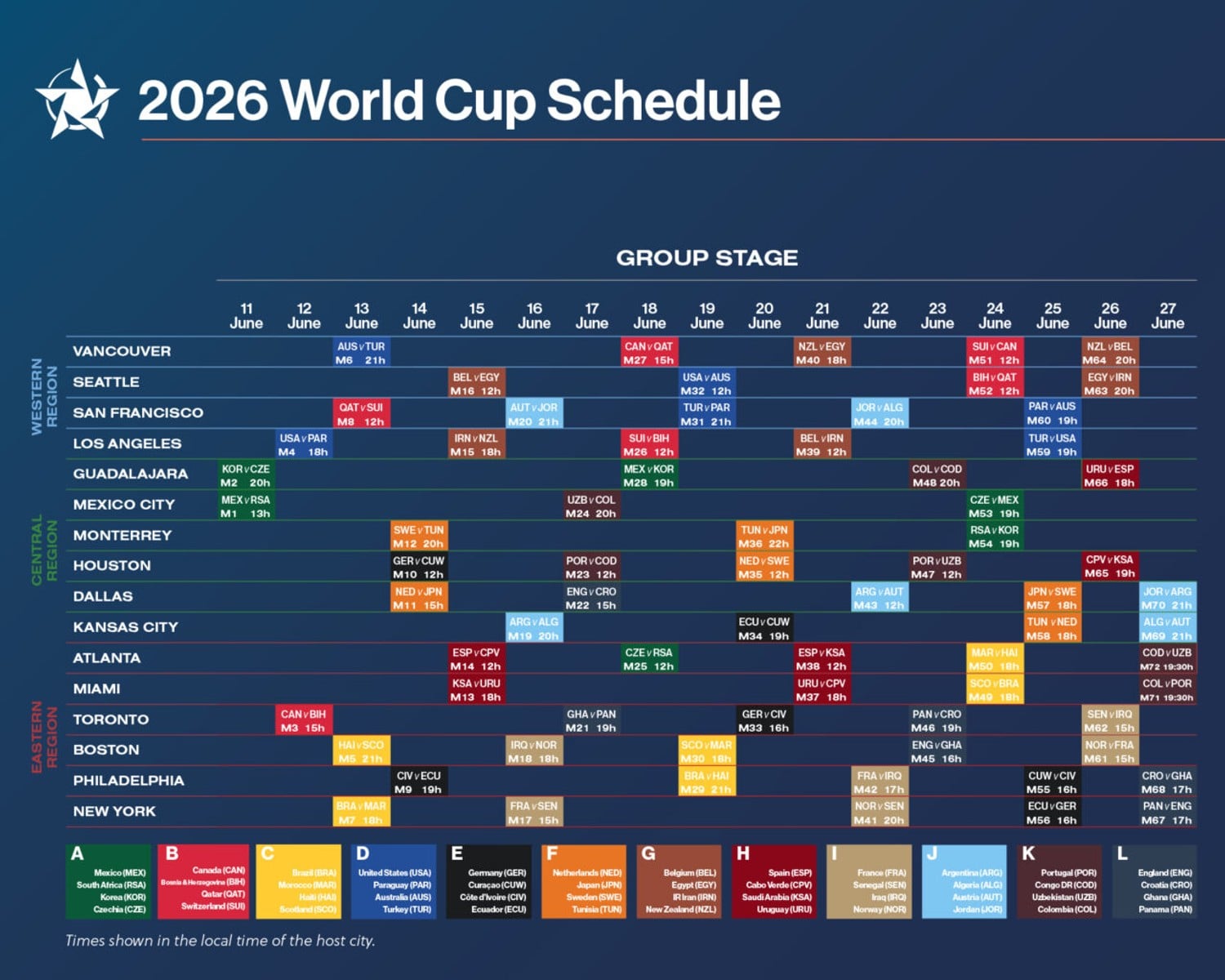
Once again: the World Cup 2026™ introduces a major structural change, almost a revolution, expanding to 48 teams divided into 12 groups and increasing the total number of matches to 104.
This new format gives more nations the opportunity to compete on the world stage, while also extending the tournament’s duration. At the same time, it reshapes the competitive dynamics, with a revised group stage and knockout pathway which maintains fans’ excitement for longer.
Of course, more countries mean more teams, more traditions, stories, languages, fan bases, and even anecdotes. For instance, the 48th place in the tournament graph went to the Qatar national team, which obtains "the worst Elo ranking." However, as ESPN notices, there has been one even worse team than Qatar—Togo in 2006. But at the same time, Togo had Emmanuel Adebayor, the active Arsenal player, when Qatar's best player is Akram Afif, who is playing for Al Sadd SC. Among teams which are placed on the lowest numbers, you can find Curaçao (47), Cape Verde (46); we can see on the list Iraq in 44th place and Haiti in 42nd. The 39th and 38th places went to Jordan and Iran, respectively. Curious, that if Iran finishes second in their group and the United States does the same, they will play each other in the round of 32. Climbing higher on the table, we see more expected teams, but we all should remember—we love football because sometimes (not often, but still) it surprises us. So, let’s hope to be surprised this summer!
Read more about the main sports industry trends 2026
The group stage this year is structured in a way that each team plays three matches within its group, facing every other team once. At the end of this stage, the top two teams from each of the 12 groups automatically join the knockout rounds. They are joined by the eight best-performing third-placed teams, creating a 32-team playoff, ensuring broader chances of progression across the tournament.
The introduction of a new—the 32nd round—adds an additional knockout stage at the start of the playoffs, also expanding the elimination phase. This increases the total number of high-stakes games, widens the tournament’s duration and gives fans more extreme win-or-go-home moments.
Time and nerve saving
At the 140th Annual General Meeting (AGM), the International Football Association Board (IFAB) introduced a package of measures aimed at increasing match tempo and reducing time-wasting. The reasoning becomes clear to anyone who has watched a game where a winning team deliberately slows play to protect the score. While these measures may seem like an attempt to optimise time for broadcasting or advertising, they in fact help ensure fairer play and allow both teams to make full use of the time available.
The measures include:
- substitutions must take no more than 10 seconds;
- a five-second countdown for throw-ins and goal kicks;
- injured players must leave the field for at least one minute.
Another set of changes concerns VAR. Previously, it was used only for four scenarios: goals, penalty decisions, direct red cards, and cases of mistaken identity. Now, referees can also use VAR in additional situations, including red cards resulting from a clearly incorrect second yellow card, cases of mistaken identity where the wrong player is penalised, and clearly incorrect corner-kick decisions.
Football fan base population
According to the EMW Report, football audiences are mostly presented by millennials, followed by Gen X. Younger fans (13–34) are also present and especially active while fueling engagement through digital platforms, discussions, and merchandise consumption.
At the same time, sports media consumption in North America (which is especially important for this year) is changing. Streaming has become as important as traditional linear TV, with a majority of fans, especially younger ones, watching live sports on subscription platforms. At the same time, this leads to consumption fragmentation, as fans often need several services to follow teams, which means higher prices and more access issues (like geo restrictions). Despite this, traditional broadcasting remains general for major events, while social media, used by over 90% of younger fans, has become central for highlights, news, and ongoing communication.
But these statistics are generic; when we are talking about the World Cup 2026, we need to focus on bilingual viewing, and approach—more countries, more fandoms. When it comes to languages, we should remember that in three host countries, people speak three languages. And imagine how many languages we will get, if we count all those used in all participating countries.
Curious facts provided by Nexxon Media:
- 14% of the audience will watch games both in English and Spanish
- 63% of the US audience will watch the tournament mainly because of the host countries
Social media usage: In retrospect and perspective
During the World Cup 2022™, in Qatar, traditional TV viewership decreased by 11.9% compared to 2018, which was caused by a shift toward multi-screen consumption. Fans were complementing live matches with digital content, and platforms like TikTok got a central role—serving both as a “second screen” for 85% of users, and a discovery engine that boosts match viewership. FIFA adopted this fans’ love for TikTok and made them the official partner last time, and the official social hub this year, which already demonstrates quite exceptional results. Last year, 1.4 million posts were placed on TikTok with the hashtag #FIFAWorldCup. It is not a secret that Gen Zers use TikTok as a search engine and a source of information and news, and throughout the tournament, it can help to grow the best metrics of the platform even more: more games, more results and news should be found.
The replacement of the linear TV with content creators can be presented with an example of the podcast “The Rest Is Football,” made by former football players Gary Lineker and Alan Shearer. This podcast reached 20 million views on YouTube during Euro 2024, which led to its being bought by Netflix. The streaming giant, rather than spending billions on broadcasting rights to games, invested 14 million pounds to stream this podcast daily during the 2026 World Cup.
In general, FIFA’s official social media accounts attracted six million new followers by the end of the Round of 16. They created a channel on WhatsApp dedicated to the tournament, which gained a total of 4.4 million followers already (the tournament hasn’t even started yet).
Protection or security
Ahead of recent tournaments, FIFA has placed increasing emphasis on protecting both fans and participants from online abuse (we covered this before the last World Cup). Their Social Media Protection Service (SMPS), developed with FIFPRO, moderates hate speech and other digital violence and has already filtered millions of harmful comments on various platforms and services. It reflects the scale of the issue, which is greatly proven by the fact that one in five players at the 2023 Women’s World Cup received abusive messages.
At the same time, FIFA’s digital ecosystem continues to expand rapidly, with millions of new social media followers, strong adoption of messaging channels like WhatsApp, and significant app downloads, underscoring the growing importance of safe and engaged online fan communities.
Community engagement on all online stadiums
Many countries have official broadcasters and media covering the tournaments and everything around football this summer. These platforms can grow user loyalty and increase metrics significantly. However, their challenge comes after the World Cup™ ends and fans leave. To keep them on the platform and grow retention, turn them into your audience, not just the World Cup™ audience. You need to create community environments that offer a unique experience and let users feel part of something bigger, sharing emotions, cheering, excitement, and disappointments.
Learn more about community chats integrated with the official broadcaster of the Qatar World Cup™
The expanded 2026 World Cup format will give fans more reasons to follow the tournament every day. Watchers helps sports, media and streaming platforms keep that conversation inside their own product with in-app community features built for live events. Even if you represent the national league or team, don’t send your fans into WhatsApp groups when you can gather them together on your own platform and stay connected.
FAQs About World Cup 2026 Format
How many teams will play in the 2026 World Cup?
48 teams will participate, making it the largest World Cup in history.
How do teams qualify from the group stage in the 2026 World Cup?
The top two teams from each group qualify, along with the eight best third-placed teams.
How does the Round of 32 work in the 2026 World Cup?
It’s a new knockout stage where 32 teams compete in single-elimination matches to advance to the Round of 16.
How could the new format change the fan experience?
More matches and teams mean greater global representation and content, but also a more complex and fragmented viewing experience.
Boost your platform with
Watchers embedded tools for ultimate engagement


