Sports App Features: What Modern Sports Platforms Should Include
Based on the recent IBM research about sports fans and their digital preferences, we are exploring what sports features are the most important right now, and what will help you to grow engagement, interaction, and improve monetisation of your app.



Fans use sports-related apps mainly to check match updates and read sports statistics, but they more and more expect a personal, interactive experience. Such an experience can be provided with sports app features like game highlights, behind-the-scenes content, live streaming, and community-building features. All of them will help audience to engage in their favourite club or media app alongside a like-minded fan community. Nobody fancies having ten apps open at the same time anymore: one for stats, one for the info, another for broadcasting, and one for chatting.
Global research by Morning Consult and IBM showed that sports fans are turning to dynamic digital content experiences, expecting deeper engagement. Technically, AI, personalisation, and real-time features are central to achieving the engagement fans seek in sports.
Grand View Research’s study shows the sports app market was valued at $3.66 billion in 2022 and is expected to grow to $8 billion by 2030. Only apps that go beyond and offer fans key opportunities for sports consumption and entertainment will succeed in the crowded market.
Sports App Features… What exactly do you mean by that?
According to the mentioned IBM report, modern sports app users find the following aspects most important:
Summarising: users need a summary of the content they viewed, listened to, read, or missed. Features for this can include game highlights, commentary, AI assistants summarising games users missed, or a short intro for a newly transferred player.
Personalisation: users want the app to consider their preferences. Customising the profile and choosing what to see and who to communicate with is as important as high-quality news recommendations. Personalisation can also include gamification elements because users earn them on their own.
Interaction: any app users, not just sports fans, seek interactions. It is a necessary part of the digital experience users expect. Many media and sports brands partner with WhatsApp or TikTok to gather their communities there, but is this a good solution and a satisfying kind of interaction? Let’s see.
Modern Sports App Features Users Expect
Let’s jump to the concrete features to see what they can give your users to make them return more. Before choosing the feature to develop, you need to specify your goals: you want to grow revenue by selling merchandise? To grow incremental value through subscriptions and memberships? Do you need to attract more sponsors and partners by showing the overall metrics growth? Or do you need to support and grow your fan base and user loyalty? By answering this, it will be easier to pick the most suitable features for your set.
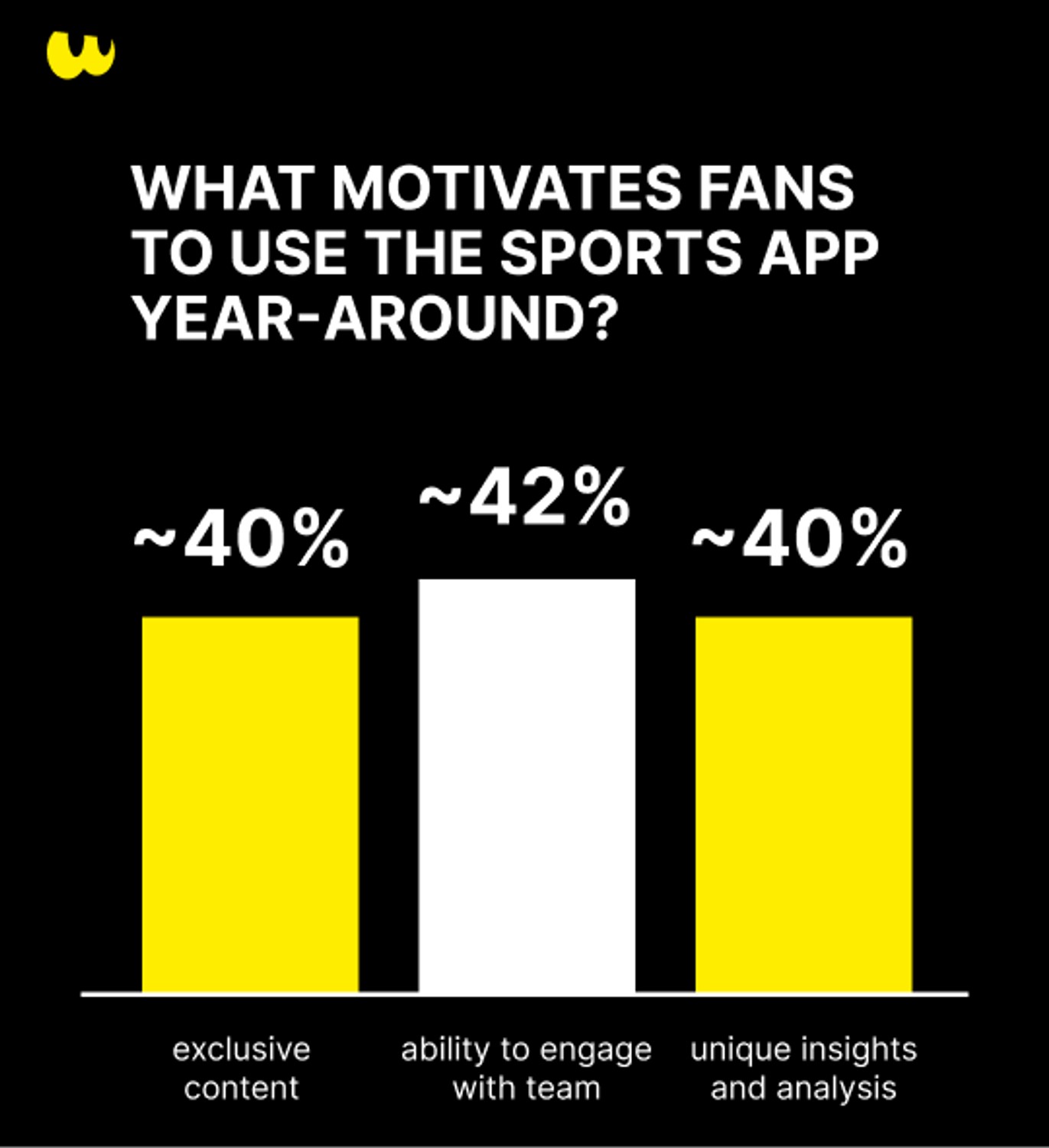
Almost 40% of sports fans expect to find all the needed information and functions in one place when using a sports app. As we wrote, nobody wants ten apps open at once while watching a football game. The most popular reasons fans mention for using sports apps:
- Real-time update
- Access to exclusive content
- More statistics
- Engaging with other fans or with the team.
Let's go through the features that can meet all these needs.
Content Features and Their Paradoxes
Modern fans expect more than mainstays from a sports app because they consume content across various formats. Imagine how much content surrounds any user on social media, VOD, broadcasters, and news media. When you start a new app or relaunch an old one, decide your content goals. You cannot compete with the variety of platforms and content providers, so don’t try. Instead, find and specify your niche.
If an app provides the same schedules, standings, news, stats, and updates as sports websites and TV channels without catering to expectations, growth is challenging. According to an IBM study, sports fans want more dynamic digital content, personalised content and real-time game updates as three things they value highly.
Over the last several years, broadcasters and industrial giants have closely followed changes in broadcasting consumption. Despite a large shift to VOD, most viewers still watch sports via linear TV. While this is good news for advertisers, it challenges brands going digital because they must compete with the TV screen. It also challenges viewers who have too many screens and platforms to consume at same time.
Short-form videos of key moments like goals, fights, and celebrations, along with interviews and behind-the-scenes content, can bolster user mainstays. Providing a space within the app where users can discuss the latest highlights and sports news boosts engagement significantly. Creating exclusive content for subscribers equips the app with an additional monetisation flow and gives users a new reason to return.
Personalisation
Personalisation involves creating opportunities for interactive content. To start personalising UX, the app can use onboarding to ask generic questions to users about their preferred teams or players, as well as personal information like age, gender, and country. So, updates, sports news feeds, and dashboard information will highlight what the user is interested in.
Dynamic adjustment within your app based on analytics of user engagement that can ensure you stay up to date on users' personalised needs. For example, if a user frequently engages with content from a particular team, that information can be used to make it available as soon as they open your app. Alerts and push notifications further reinforce personalisation by pushing out information your customers care about.
Personalisation is also connected not only with recommendations based on data but also with the experience which the user can personalise on their own: for instance, customise the profile with images, colours, names, or any other elements. On the other hand, users can participate in gamifying offers and achieve personal trifles they will like and stick to, and which will make their profile and their experience with this app unique.
Interactive Features
Creating that interactivity can be quite simple by creating polls around predictions regarding upcoming games or post-game polls about star players, as well as weekly quizzes. Providing in-app opportunities for predicting the outcome of matches with winners declared at the end can also lead fans to be more invested.
Fantasy sports tools can be another workable interactive feature. With them, users can create a fantasy team to earn points based on the real-world performance of the athletes they choose. Fantasy sports work perfectly with community rooms, as they put the experience of fantasy leagues into live interaction with a real community.
Community Features Inside a Sports App
According to IBM, many more fans prioritise сommunity engagement in sports in 2025, compared to 2024. A good sports community app today requires a place within it where sports fans can communicate. That means creating community rooms, allowing commenting and discussion on news or events, or just chatting between matches. Without a community engagement feature, there is little reason for users to open up your app before, during, and after events beyond a simple stat checking. The IBM study we mentioned also revealed that over 80% of sports app users use their apps during events, and even a larger percentage of those users use them during live events.
What’s specifically important is that community-building tools are strongly connected with other features mentioned. When users’ conversations take place within the sports app, all their data is held within the app. It helps the app owners strengthen the relationship with users, develop personalisation and optimise offers for more opt-in services.
As for various types of sports, communities inside apps are most preferable by football and golf fans. Globally, 53% of sports fans seek community engagement if not separate them into various kinds of sports.
Except the necessity for users, community features allow you to keep all first party data inside your app which become more valuable, and increase retention—users will come back to your app’s communities, nit in the messages and Instagram.
Read about first party data usages
Moderation and Safety Concerns
When the fandom came into the official app, risks also came. Community chats and real-time messaging not only provide users with the tools to connect, but at the same time, the passions of sports fans can lead to derogatory comments being posted. So, safety features like content and community moderation tools are essential.
Read about AI moderation systems more
Today, moderation must include many levels and be cascaded to protect users, the brand, athletes, and all possible participants of the sports consumption and circulation. Block filtering, AI flagging, and tools for users to provide a secure space for themselves are usually included in the moderation pack for any community-building app.
Sports have their own specificities being one of the most multicultural and multinational industries which, unfortunately, still cannot get rid of racism and other violent behaviour. But with the moderation system built right and attentively, the community which is gathering in the team app will be much safer than gathering on social media, where these situations are uncontrolled.
AI Agents and Assistants
AI is rapidly becoming a core part of the sports fan experience. As you remember, we mentioned that summarising is extremely important for sports fans: the summary of the game, tournament, team performance, the short info about what is happening in the other team group can be easily provided by AI.
AI can be a good assistant in the search for any sports-related information: for instance, if fans want to estimate the statistics of the new transfer. If such an assistant does not live in the external service, but inside the team’s app, fans will have many more reasons to spend time there or even pay for a subscription.
Learn more about AI sports assistant
Monetisation Features
Obviously, monetisation tools meet the needs of the brand much more than fans. Still, if the brand organises them in the right way, they can meet users' necessities too.
Monetisation tools can include merchandise shops, subscription and membership models of usage, sponsorship deals: when fans watch 5-hour tennis, they can both buy a tennis kit for training and order some food, and if these can be done through the same tennis app, where they communicate with teammates and read live comments, this experience will be full.
Internal ads remain the main tool for monetisation of the services and platforms, and people more often claim that they are ready to watch advertisements if they can get exclusive content for a lower price.
How to Choose the Right Features for Sports Apps
A single sports app doesn’t need to be everything all at once, and the features chosen should be dependent on the audience, platform style, goals, and capacity to execute. What kind of app do you develop: club app, league app, live score apps, sports media app, OTT / streaming platform, event or tournament app, sports fan app?
Your target audience will also help you shape which features you should roll out first. For example, a study by Parks Associates indicates that younger audiences want highlights, interactivity, and social media engagement from mobile sports apps. Younger fans are more likely to engage with interactive features like live stats, polls, fantasy sports, and integrated gaming.
Checklist for choosing sports app features:
- Choose the core feature of your app
- Find ways of monetisation
- Find out how you will collect, store, and use user data
- Choose the ways to personalise the user experience
- Estimate what type of gamification suits you the most
- Decide which place the community will have in your app and the ways users will communicate with each other or with the team
- Organise a moderation system for fan chats
- Add clear and engaging onboarding
- Choose which type of exclusive content you can provide for users
- Integrate an AI bot to cover users’ needs.
Fast and Easy Integration of Community and Interactive Features
With Watchers, you don’t need to build the community features from scratch: integrate communication chats, live streaming, community podcast tight in your app, gamification, and AI sports assistant help you to give your users a deep and interactive experience. Try Watchers, and build the community strategy with us and observe your metrics’ growth.
FAQs About Sports App Features
What are sports app features?
Sports app features are the specific tools created and integrated to improve the experience for users. Usually, they can be divided into three categories: engagement, like polls or community chats, utility, like match updates, and monetisation, like upsell widgets.
What features should a sports app have?
A sports app should include this list of core features:
· Real-Time Alerts: Instant scores, stats, schedules, standings, fixtures, team profiles, and news feed
· Live Coverage: Video streaming or real-time commentary.
· Interactivity: Fantasy leagues and real-time community chats.
· Gamification: Achievements, badges, other rewards.
Why do sports apps need community features?
Community features allow fans to share their emotions about the match in real time, creating the atmosphere of a real stadium. This interaction builds user loyalty with the brand app and keeps fans engaged long after the end of the game.
Learn more about current trends in the sports industry
Resources
- IBM Study: Sports Fans Demand More Dynamic Digital Content, Powered by AI
- Grand View Research Sports App Market Size, Share And Growth Report, 2030
- Activate Report Activate Consulting Technology & Media Outlook 2025
- Parks Associates Study Younger Sports Fans Shift Viewing Habits, Creating New Opportunities for Streaming Services
- ESPN: Live Sports & Scores App - App Store
- Gen Zers would trade more ads for lower streaming costs as prices rise
- Sports Fan Engagement, Content Monetisation & AI Trends Survey
Boost your platform with
Watchers embedded tools for ultimate engagement


