World Cup 2026 Fan Zones: Where Offline Football Culture Meets Online Communities
That's a year of football and a summer of football, a time of new trends. How do offline fan zones and online fan experiences influence each other and help fan communities literally breathe football?



The FIFA World Cup™ 2026, hosted by the United States, Mexico, and Canada, is already here. The hype is at its peak. Around two million tickets were sold in the first two phases, and more fans from around the world continue to purchase tickets. However, many fans are also gearing up to enjoy the groundbreaking tournament in fan zones.
Fans today don’t just want to watch a match but to share the excitement and enjoy the unforgettable moments of their favourite team with their mates. Fan zones offer those experiences. For those who can’t attend the match at the stadium, World Cup™ fan zones are the perfect alternative, where they can experience the tournament atmosphere and react together with other supporters. Yet, fans want to experience the same feelings digitally too, as they increasingly use in-app communities to follow live matches, share reactions, join discussions, and celebrate moments with other fans.
Let’s explore why fan zones matter so much and what sports platforms can learn from them.
Why World Cup™ 2026 fan zones matter
The FIFA World Cup™ is one of the most followed football events, watched by millions of fans around the world. Every true fan wants to experience the action in the stadium, but not everyone gets the chance. Limited stadium capacity, ticket prices, travelling, and visa issues restrict many fans from attending the matches in stadiums.
Fan zones filled that void. They are purpose-built areas to let fans enjoy matches with thousands of other enthusiastic supporters on giant LED screens and feel the World Cup™ atmosphere even without a stadium ticket. These spaces create a sense of community as football fans from different countries come together in one place to support their favourite teams.
When a huge number of fans gathered in public spaces during the 2002 World Cup™ to enjoy the matches together, it was a clear sign that fans wanted more than just the game. They wanted to share the excitement and enjoy the action with friends, family, and other supporters.
This led to the first official FIFA Fan Festival at the 2006 World Cup™ in Germany, and since then, the FIFA Fan
The festival has become an event of its own with big screens, live entertainment, food, and merchandise stalls.
The FIFA Fan Fest at Copacabana Beach during the 2014 World Cup™ became one of the tournament's defining images. Thousands of fans packed the fanzone throughout the tournament, watching the matches on giant screens with the sun blazing overhead. FIFA itself said that some aerial photographs of Copacabana had barely a grain of sand visible, which reflects the spirit of the Fan Fest.
During the last World Cup™ (Qatar 2022), around 1.86 million fans watched matches at the FIFA Fan Festival in Doha, and FIFA-supported fan zones outside the host country also accommodated nearly 460,000 fans.
FIFA has also officially announced Fan Festival sites across the host cities for the 2026 World Cup™ to let fans be part of the action and celebrate together. Individual host cities are also creating their own fan engagement plans. Recently, the Los Angeles World Cup™ 2026 Host Committee announced football fan zones and multiple community events across Los Angeles. New York and New Jersey have also confirmed free official fan events throughout the tournament.
World Cup™ 2026 fan zones are being built at scale because the demand is real and worth investing in. The atmosphere is not a bonus on top of the actual game. For most fans, it is a necessary part of major events. For example, Paris built one of the largest fan zones, with an area of around 130,000 square meters and capacity to accommodate 90,000 fans at a time, at the Champ de Mars for UEFA Euro 2016. Thousands of fans watched matches on a giant screen directly in front of the famous Eiffel Tower itself. Demand was so intense that on the night of the final, the zone reached capacity several hours before kickoff.
Why football is built around shared moments
Football, by nature, is a co-viewing experience; millions of fans watch the same match at the same time. When a last-minute goal is scored or a sudden red card penalty is given, it leaves fans in disbelief or sheer happiness, and they want to share these emotions with others in real-time.
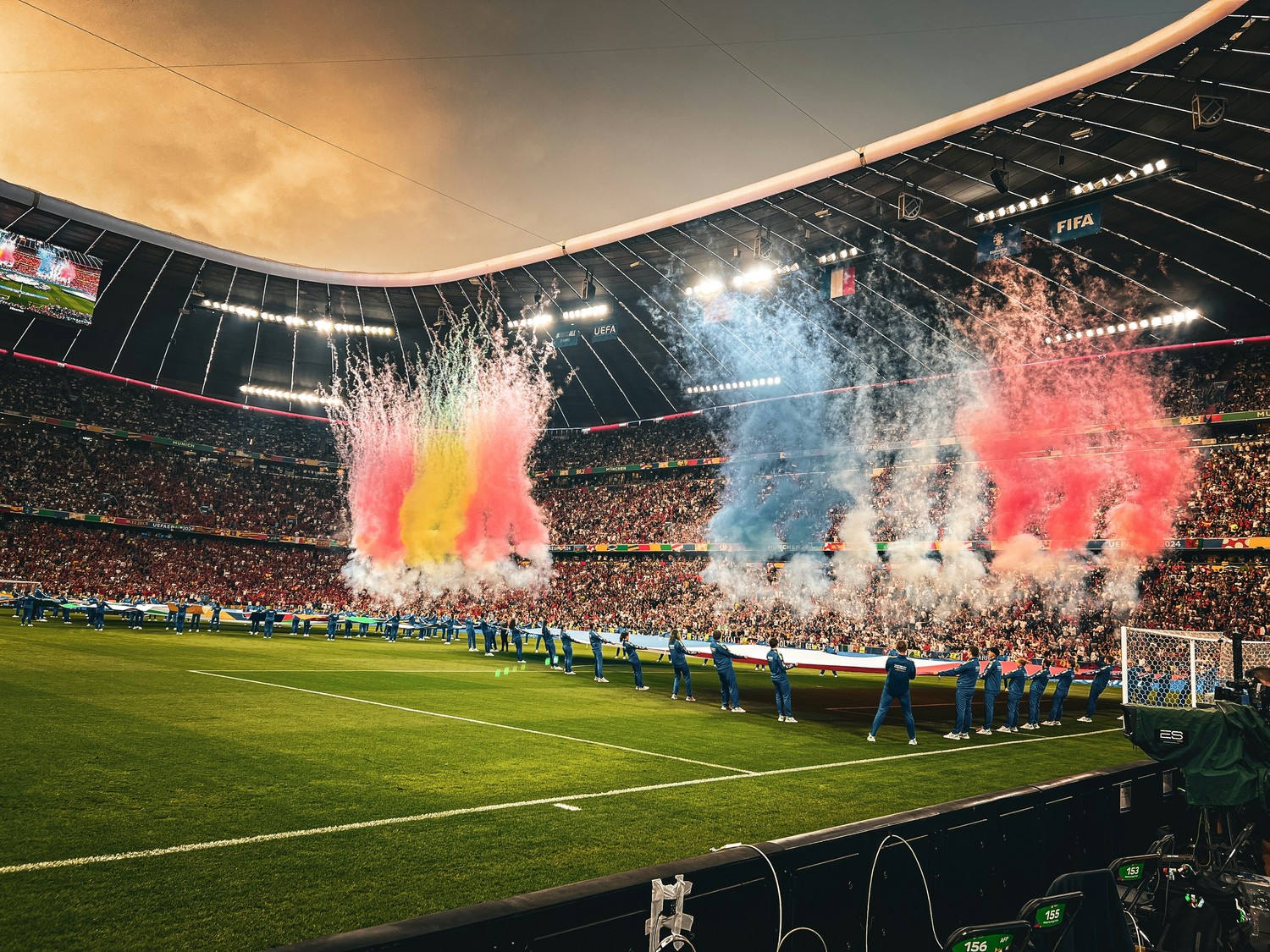
Those present in the stadium or fan zones turn to whoever is next to them, even if it’s a total stranger. Those watching at home quickly reach for their phone to share their reaction in communities. And this reaction doesn’t stop once the game ends. A single refereeing decision or crucial goal can dominate football communities for weeks. Frank Lampard’s famous “ghost goal” during the 2010 World Cup™ led to a global debate and became one of the most widely discussed refereeing controversies of the World Cup™.
Besides these reactions, fans also inform each other, such as an injury spotted in the warm-up or a tactical shift mid-game, exchange predictions, debate substitutions, and share player heat maps. For example, Reddit communities such as r/soccer run live match threads for major games where fans post and discuss the game.
LMU Munich research shows that discussions on Reddit are usually organised into pre-, live-, and post-event threads, which enables continuous interaction during and after matches and turns passive viewing into an active, shared experience. A recent study made at Northeastern University in London also found that conversations on the platform intensify and become more focused as major events, including sports events, approach.
Not just Reddit, engagement is naturally high on other popular platforms as well during major events like the World Cup™. The last World Cup™ in Qatar engaged five billion fans worldwide, which made it the most followed World Cup™ ever. The final between France and Argentina alone had the highest viewership ever for any single sporting event, with 1.42 billion viewers.
The social media numbers are also huge. There were a whopping 93.6 million posts across all platforms during the tournament. The 262 billion cumulative reach and 5.95 billion engagements are a reflection of how millions of people reacted, shared, and discussed matches.
FIFA President Gianni Infantino also recently said: "The world needs occasions of unity, of bringing teams together, of bringing people together, of bringing fans together. We are expecting millions of fans to come to the United States, Canada, and Mexico next year. We want it to be a celebration, and everyone is committed to making this happen." The statement shows how football is seen as a global sport for unity and shared experiences.
What sports platforms can learn from fan zones?
Fan zones are popular not because of live shows or food stalls. While these are added values, the true reason why a fan watches a match in a fan zone is because of the shared experience. But beyond these shared experiences, fans also want access to other features like stats and analysis. A survey from Deloitte revealed that as many as 77% of fans do additional activities like looking up stats, social media, and fantasy sports while watching sports. Another Deloitte study found that 58% of sports fans say that they want access to the same statistics, analysis, and replays at a live sporting event that they get at home. This figure jumps to nearly 70% for Gen Z and millennial fans.
To meet this demand, many fans' zones today add interactive features to increase fan engagement: interactive screens that show live match updates, player stats, polls, AR and VR features that enable fans to engage with their teams and players virtually, interaction stations with activities like skill and leaderboard competitions, and social media booths to allow fans to share their reactions in real-time and post pictures.
These features are even being offered in the stadium to enhance the live game experience. For example, FIFA introduced the FIFA+ Stadium Experience for the 2022 World Cup™. It was available in-app to fans on the ground in Qatar and provided a live AR overlay of stats, heat maps, VAR replays, and more to enhance the live game experience.

This idea does not apply only to fan zones or physical spaces. It simply shows that football fans around the world want to share their reactions with other fans during and after the match, and they want access to in-depth match data and interactive features that enhance the viewing experience.
Sports streaming services, official club apps, and dedicated second-screen companion apps can provide an enhanced experience through features like an in-app live chat, fan rooms, polls, post-match discussion, statistics, and analytics.
Platforms that provide these features will automatically attract more fans and increase engagement. For example, FC Barcelona integrated an AI chatbot (Futbot) into its official Discord channel, which gives fans access to real-time statistics, analysis, and polls during live matches. The peak activity on the channel is around 60,000 messages on match days. The club built the chatbot deliberately because fans were already informing and debating each other, and these features helped increase the engagement.
Content localisation is another feature that can boost engagement. As La Liga’s Southeast Asia managing director, Ivan Codina, said, they actively create localised content for Asian fans. In fact, La Liga is active on over 20 platforms worldwide and communicates in more than 25 different languages to reach global fans.
The ultimate goal for these sports platforms is to provide a stadium-like environment digitally, while also fulfilling fans’ demands for interactive features and match data.
What happens when the conversation leaves the app
When a sports app or streaming platform doesn’t have live chat or community, fans move the match discussion to other platforms like WhatsApp, Telegram, X, and Reddit.
According to Deloitte's 2026 Digital Media Trends survey, 44% of fans say they typically find content on social media and then watch or buy the full version elsewhere, such as a streaming platform. LaLiga Tech and Nielsen's 360 Fan Engagement Report also found that 41% of sports fans around the world watch at least some events on OTT platforms via streaming apps.
This shows that fans are on the platform and ready to engage, but when the platform lacks the features they need, they leave the platform. Sports apps and streaming platforms miss the huge opportunity to increase engagement and build long-term retention.
From public viewing to in-app communities
The purpose of fan zones is pretty simple: to provide football fans with a way to enjoy the action with hundreds of other fans, share emotions and reactions, and celebrate together. In-app communities work the same way, but instead of physical interaction, fans share their emotions digitally.
In fact, online communities hold lots of importance for fans, as many say community engagement is one of their top priorities when watching sports content. An IBM survey showed that community engagement was the top priority of 9% of fans in 2024, and it increased to 11% in 2025. If we look at fan behaviour and trends, this number is only expected to increase in the coming years.
Apps with features like live chat, fan rooms, reactions, polls, Q&A, post-match discussions, and personalisation keep fans engaged and make them come back to the platform because they cater to the needs of fans.
Live chat gives fans a way to react to the game as the action happens. Fan rooms give supporters a sense of belonging to a particular community. Polls and Q&A features are additional ways to participate beyond passive watching. Personalised content makes fans even more invested in the platform. FIFA added personalisation directly as part of its app for the 2022 World Cup™. Fans could register for free, choose their favourite World Cup™ team, and get tournament news, highlights, and analysis relevant specifically to them.
Why the World Cup™ 2026 will test digital fan engagement
The World Cup™ 2026 is longer than the last World Cup™, with more teams and more matches. For fans, it means more entertainment, but for sports platforms, it’s a real opportunity as well as a challenge.
With 48 teams and 104 matches, sports platforms now have to put more effort into maintaining engagement across the entire tournament. They have to cater to the needs of more fan bases and manage engagement across multiple games running at the same time. More host cities also mean a more diverse audience, and the platforms need to deal with multiple time zones.
And with increasing fan demands, things are even more challenging for sports platforms. Fans were already demanding features like live chat, reactions, fan rooms, polls, Q&A, and post-match discussions. They now also want additional features. An IBM survey revealed that more than 50% of fans want AI-powered sports commentary and insights for sports events. The same survey showed that:
* 51% of fans want video highlights
* 37% want post-event recaps
* 32% want player interviews to stay connected to their favourite sports
LaLiga Tech and Nielsen 360 Fan Engagement Report also revealed that 55% of Gen Z want to see and interact with live statistics during play.
Sports platforms that implement these features and provide structured content are more likely to succeed in capturing and engaging a global audience.
Why live football needs moderation and fast context
Having a live chat in your sports app is expected to increase engagement, but it is not a sure-shot way to increase retention. If you leave the chat unmoderated, spam, insults, toxicity, and abuse quickly become part of the chat, which leads to fans leaving the chat and even the platform.
During the last World Cup™, FIFA's Social Media Protection Service scanned over 20 million posts and comments across social media posts and comments on platforms like Twitter, Instagram, Facebook, TikTok, and YouTube throughout the tournament. Of those, 19,636 posts and comments were confirmed as abusive, discriminatory, or threatening and were reported to the platforms. 26% was labelled as general abuse, 17% was sexual in nature, 13% was sexism, 12% homophobia, and 11% racism.
When everyone reacts at the same time, there are thousands of messages to manage, which requires quick moderation. To tackle such situations, FIFA used a software tool during the last World Cup™ that could automatically detect and hide abusive and offensive comments posted directly on players' and teams' own Instagram, Facebook, and YouTube accounts, if permission was granted by the account holder. Through this tool, 286,895 comments were hidden from public view across the tournament.
Moderation, which can be through AI-powered filtering and community reporting tools, is not optional but necessary now.
In addition to moderation, sports fans also want quick answers to their questions when watching a match. For example, when a goal is disallowed, many ask why: was it offside, a handball, or a foul? Many are also confused by the constantly updated rules of the game and have questions when they don’t understand why something happened during the game.
AI-powered Q&A tools can be genuinely useful in such cases. For example, La Liga built an Azure-based conversational AI in 2019 that lets fans ask questions about players, teams, and the fantasy league through a voice-based AI assistant. These AI-powered tools can also be embedded in live chats so fans don’t leave the app.
What sports brands can prepare before the tournament
Here’s a practical list for sports brands and platforms to prepare before the tournament kicks off:
- Live match chat: A must-have feature to provide fans with a way to discuss the game as the action happens
- Tournament communities and fan rooms: Give supporters a space that feels like theirs
- Reactions and polls: Quick ways to engage fans during and after the match
- AI-powered Q&A: AI chatbots specifically trained to answer football fans' questions during the game.
- Moderation: Clear moderation rules, which should be communicated to the community before the tournament begins
- Post-match discussion threads: To keep the fans engaged even after the game ends
Keeping the World Cup™ conversation inside the app
The fan zones being built for the World Cup™ 2026 fan experience will most certainly be full. But the real challenge is for sports platforms that need to keep fans engaged throughout the tournament. Live match chat, fan rooms, real-time reactions, AI-powered Q&A, and post-match discussion are the features that will make the real difference.
Ready to increase fan engagement and user retention and build communities on your sports platforms? Book a demo with Watchers to keep the conversation inside your app. Connect with us, and we will help you to create a digital environment inside your app.
FAQs about World Cup™ 2026 fan zones and digital fan communities
What are World Cup™ 2026 fan zones?
These are purpose-built public viewing areas set up by FIFA across all host cities in the United States, Canada, and Mexico. They give fans a place to watch matches on large screens and meet other supporters.
What is the FIFA Fan Festival?
The FIFA Fan Festival is FIFA's official fan event, which offers live match screenings, entertainment, cultural performances, and fan activations.
Why are fan zones important for football fans?
They give supporters a place to react, celebrate together, and enjoy the World Cup™ atmosphere even away from the stadium.
How can sports apps recreate the fan zone experience online?
By building a community that offers features like live match chat, fan rooms organised around teams or tournaments, real-time reactions, polls, AI-powered Q&A, and post-match discussion threads.
References
FIFA News: Nearly two million tickets sold
FIFA Fan Festival at FIFA World Cup Qatar 2022™
FIFA Football Unites the World campaign
FIFA World Cup Qatar 2022 annual report
IBM Study: Sports Fans Demand More Dynamic Digital Content, Powered by AI
Tackling online abuse at the FIFA World Cup Qatar 2022™
LaLiga Tech and Nielsen's 360 Fan Engagement Report
FIFA+: Redefining the FIFA Digital Fan Experience for FIFA World Cup Qatar 2022™
More nations, more measures, more fun? What does this new World Cup 2026™ format mean
Sports App Features: What Modern Sports Platforms Should Include
Boost your platform with
Watchers embedded tools for ultimate engagement


